How Nordlith makes work move more reliably.
We start by finding the friction, shape a practical response, put it into the work, and make sure it holds. The goal is clearer follow-through without handing judgment away.
A clear system is easier to trust.
Useful AI connects the work arriving across the business with clearer decisions, stronger follow-through, and a reliable view of what needs attention.
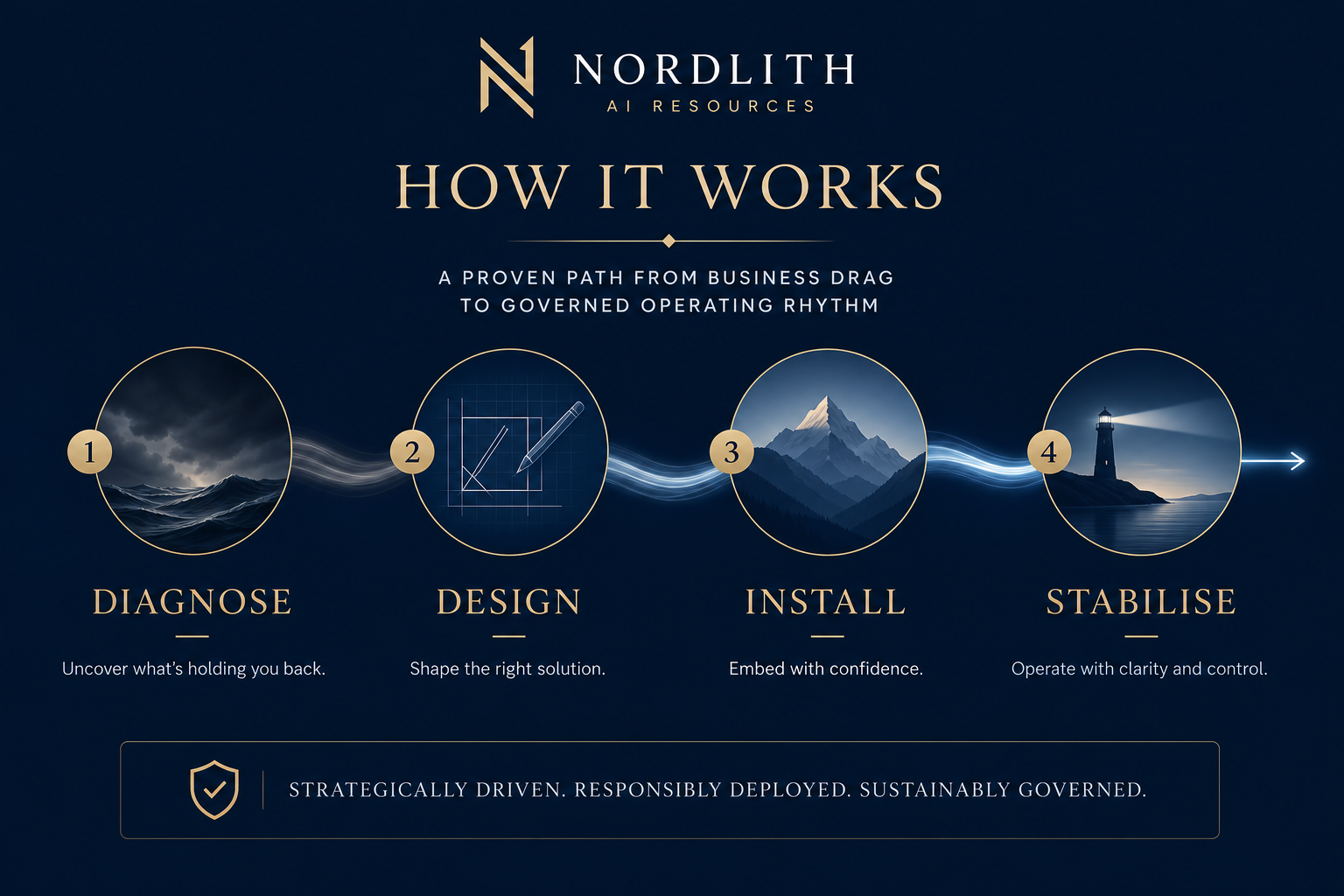
Diagnose. Design. Install. Stabilise.
This is how Nordlith determines what will make the most practical difference: automation, connected systems, AI support, better reporting, or a measured combination.
Diagnose
Find where drag, loose ends, reporting delay, AI underuse, and decision bottlenecks are slowing the company down.
Design
Choose the practical combination of automation, connected systems, AI support, and reporting that fits the work.
Install
Put the chosen system into real use so the business gains capacity, clearer visibility, and more reliable movement.
Stabilise
Turn the new model into something repeatable, governed, and ready to scale across more workflows, teams, or professional contexts later.
Human-supervised. Practical. Verification-backed.
Leadership keeps judgment, governance, and escalation authority.
The technology carries useful context, reporting load, and routine follow-through where appropriate, without removing human judgment from the operating loop.
Real outputs and checked state matter more than elegant claims.
Lessons should become stronger rules, routines, and future readiness.
See how the Nordlith model translates by city.
The locations hub gives local landing pages for Sydney, Melbourne, Brisbane, Perth, and Adelaide so businesses can enter the Nordlith model from a more region-specific starting point without losing the broader company logic.
If your business is carrying more drag than it should, start the conversation.
Tell us where work is getting stuck and we will help you identify the most useful first step.